
¶ Images. Any images included in this post may be used under the terms of the Creative Commons CC BY 4.0 license.
¶ Images. Any images included in this post may be used under the terms of the Creative Commons CC BY 4.0 license.

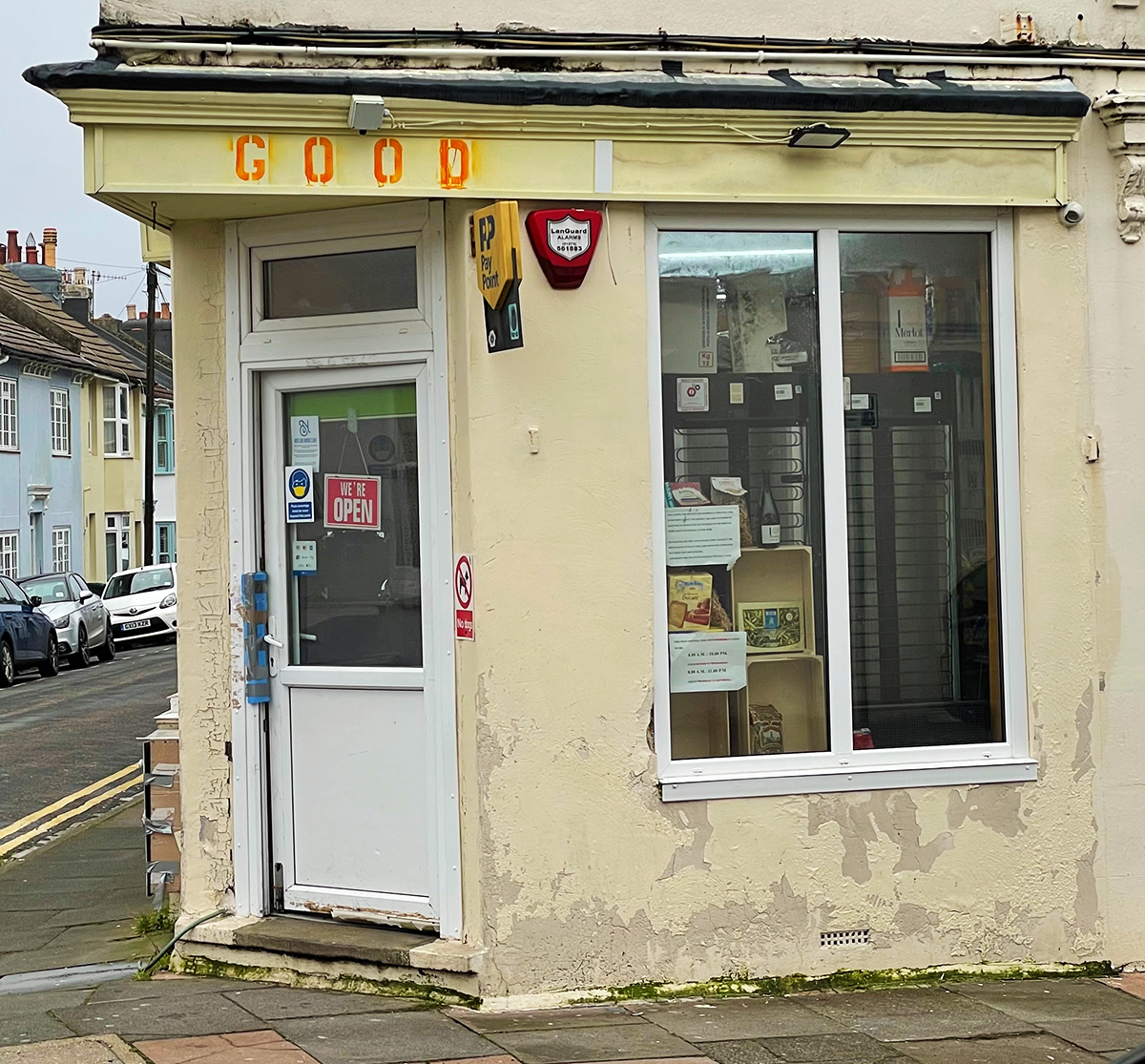
I have no idea how this patch of wall came to look this good, but here’s the story I tell myself. The proprietors, tired of the front of their building being used as an advertising hoarding, come around regularly with a scraper. They do not bother to entirely remove any of the bills and flyers: why leave a pristine surface for the fly-posters? They only make sure that no meaningful message remains. Maximum disruption from minimum effort. They leave the ‘100%’ at the bottom right unmolested as a self-assessment of a job well done.
¶ Images. Any images included in this post may be used under the terms of the Creative Commons CC BY 4.0 license.

Hamish Hamilton / 1990 / 432 pp
One might consider that Alexander Lawson was rounding up the usual suspects in the typefaces he chose to profile here. Most of them are the old style (serifed) ones that remain overwhelmingly dominant for setting books. But when he wrote these thorough essays the digital boom in typeface design was just beginning. In this light the choices are excellent and many of the faces included here have been inspirations for what has come since.

Hartley & Marks / Fourth Edition / 2012 / 400 pp
Robert Bringhurst’s book (now often referred to simply as Bringhurst) has become a standard desk-reference on typography, particularly where it concerns editorial design. He is uncommonly observant of writing systems other than the Latin alphabet: a vast area which is often all but unmapped in other English language books on the subject.
¶ The fourth edition of The Elements of Typgraphic Style is widely available from booksellers.

Lund Humphries / 1991 / 182 pp / Translated from the German by Hajo Hadeler / Edited, with an introduction, by Robert Bringhurst
Originally published in German as Ausgewälte Aufsätz über Fragen der Gestalt des Buches und der Typographie in 1975, the pieces collected here were written after Tschichold had tempered his promotion of the ideas he had developed in Die neue Typographie (1928) and Typographishe Gestaltung (1935). Books of advice on the practise of typography often tend to the authoritarian and The Form of the Book is far from an exception: the tone of Tschichold’s entertaining essays is bracingly bossy. But among his firm admonitions I’d take exception to this one about dust jackets:
The jacket is first and foremost a small poster, an eye-catcher, where much is allowed that would be unseemly within the pages of the book itself . . . as a rule book jackets belong in the wastepaper basket, like empty cigarette packages.
In the case of this volume one would be deprived of Frank Bollinger’s photograph of its exacting author on the back flap.


Yale University Press / third edition / 1983 / 392 pp
This 1983 edition is the most up-to-date so it has nothing to say about many of the digital processes now used in putting books together. It remains valuable for what Williamson has to say about the processes which haven’t changed, and for its overview of vanishing and vanished crafts and technologies.


Hyphen Press / new edition / 2008 / 64 pp / Translated from the German by Charles Whitehouse
The organising principle of Jost Hochuli’s Detail in typography, as announced in its subtitle, is broadly speaking smaller-to-bigger. The column is the largest element he deals with specifically, only tangentially addressing larger design decisions about structure, layout, illustration and production. The book is about how to make text legible and elegant at the micro-typographic level; Hochuli’s advice here is not about how to catch the reader’s eye, but how to avoid snagging it.
¶ Originally published in 1987 by Compugraphic Corporation, a revised edition was issued by Verlag Niggli AG in 2005. Hyphen Press have wound down their publishing activities, and have passed Detail in typography on to Éditions B42 whose edition came out in 2015.